Elephant toothpaste (with 3% hydrogen peroxide)
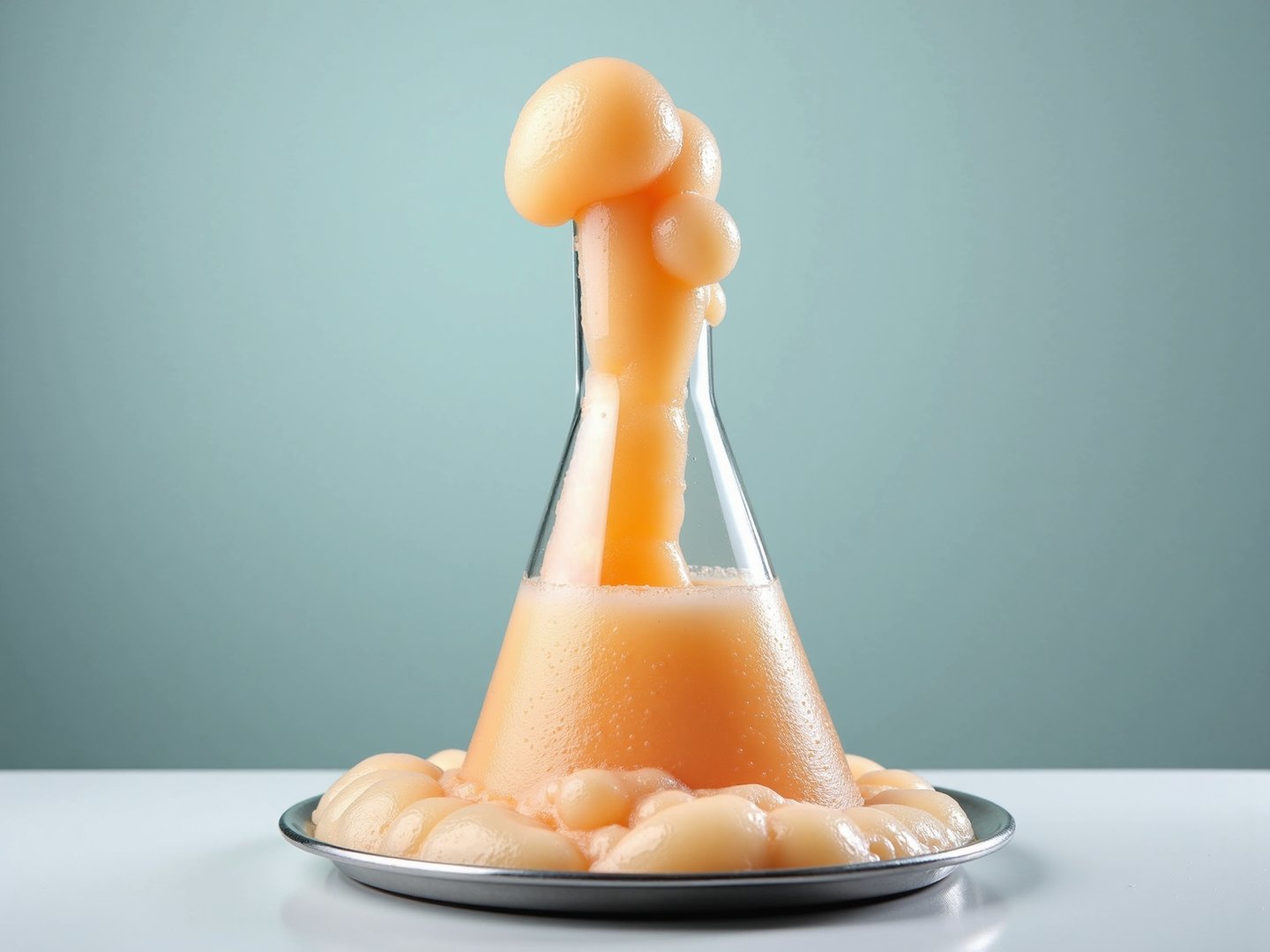
Recommended age: 10+. Adult supervision required! With the help of yeast we conjure a thick snake of foam from pharmacy-grade 3% hydrogen peroxide — the safe, at-home version of the classic elephant toothpaste.

Chemicals
- 100 ml 3% hydrogen peroxide (pharmacy grade; NEVER use a stronger concentration) — pharmacy grade; NEVER use a stronger concentration
- 7 g dried yeast (1 sachet) — 1 sachet
- 3 tbsp warm water for the yeast (about 40 °C, pleasantly lukewarm) — about 40 °C, pleasantly lukewarm
- 1 tbsp dish soap
- pc food colouring (a few drops, optional) — a few drops, optional
Procedure
-
Use only 3% pharmacy-grade hydrogen peroxide — stronger peroxide is corrosive and forbidden at home! Goggles, gloves and a lab coat (or old clothes) are mandatory, because peroxide irritates the eyes and bleaches clothing. The adult pours the peroxide and combines the mixtures, and nobody leans over the bottle during the eruption.
Safety! -
Stand the bottle in the middle of the deep tray — the tray will catch the overflowing foam.
-
The adult pours 100 ml of 3% hydrogen peroxide into the bottle through the funnel.
-
Add the tablespoon of dish soap, then gently swirl the bottle to mix.
-
If you want striped 'toothpaste', do not stir the food colouring in — trickle it around the inside wall of the bottle, and the erupting foam will carry beautiful spiral stripes.
Technique -
In the small cup, stir the yeast into the 3 tablespoons of lukewarm water until smooth. Important: the water must be only pleasantly warm — hot water kills the yeast and the foam never comes.
-
Make your prediction: what will happen, and how tall will the foam be? Once the guess is in, the adult pours the yeast mixture into the bottle in one go, and everyone steps back.
-
Watch the thick snake of foam pushing out of the bottle! Gently touch the SIDE of the bottle: it is warm — the reaction releases heat too.
-
Experiment with safe variations: more or less dish soap, a wider bottle, cooler yeast water. But NEVER increase the peroxide concentration! At the end, rinse everything with plenty of water and wash your hands.
Apparatus
- 1× plastic bottle — 0,5 l, szűk nyakú
- 1× deep tray or baking pan
- 1× small cup for the yeast
- 1× spoon
- 1× funnel
Frequently asked questions
- Why does it work?
- Hydrogen peroxide slowly breaks down into water and oxygen gas on its own. The catalase enzyme in yeast whips this decomposition into overdrive — the enzyme is a catalyst: it speeds up the reaction without being used up. The dish soap traps the sudden burst of tiny oxygen bubbles into a dense foam.
- Why is only 3% peroxide allowed?
- Spectacular videos often use 30% peroxide — a corrosive chemical that causes white burns on skin and serious eye injuries, so it has no place at home in any form. The 3% pharmacy solution shows exactly the same chemistry, safely. Do not buy stronger peroxide, and do not accept anyone offering to 'upgrade' the experiment.
- Why did I get so little foam?
- There are three suspects: old, exhausted yeast; water that was too hot and killed the enzyme; or peroxide from a long-opened, aged bottle. With fresh yeast, lukewarm water and freshly opened peroxide, the foam will be spectacular.
Share
Gallery — every version of this photo
Every version of this image is kept. Nothing here was photographed in a lab — the illustrations are generated on ATAILA hardware, and when the models or the prompt improve we regenerate and keep the old one so the difference is visible.
 Uploaded photo — not generated
